What is new
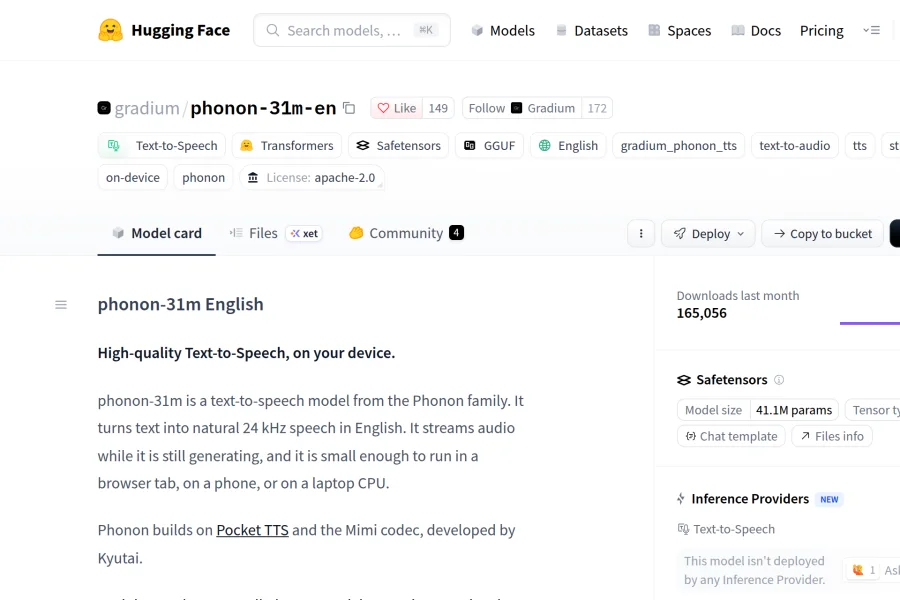
Hugging Face has posted a retrospective on Phonon, the text-to-speech model it announced in April. The company says the six months since then went into work with partners and early users. Phonon is built to run on the device itself, with no server and no network connection.
There are two sizes, about 65 MB and 75 MB. Phonon 31m speaks English. Phonon 40m covers English, French, German, Spanish and Portuguese under a non-commercial license. Hugging Face says there are more than 100 built-in voices, and users can create their own in Gradium Studio.
Hugging Face says Phonon was downloaded more than 200,000 times in its first two weeks and is still trending on Hugging Face. The company also says Phonon ranks first in German and Spanish on intelligibility on the Hugging Face Open TTS Leaderboard, and in the top three in every language it evaluated. Those are the company's own claims.
Access, licenses and pricing
Phonon 31m is Apache 2.0, so Hugging Face says it can be used for free, including inside commercial products. The other models are CC BY-NC and free for non-commercial projects. For commercial use of those models, Hugging Face says pricing is based on the number of users, not on how much speech is generated. The company did not publish prices or tiers.
Phonon runs on phones, laptops, single-board computers and in a browser tab. It is also available in Transformers from v5.21 as its reference PyTorch implementation. The ptts inference framework built for Phonon supports more than 10 backends across CPU, GPU and NPU, according to the company.
Hugging Face notes that training was initially numerically unstable and needed several tricks to work. It also says voice cloning requires the speaker's consent.
What it means for creators and sellers
For teams that need voiceover on a laptop or phone, an on-device model may remove the step of sending scripts to a server. That can matter for quick drafts, internal review cuts, or work on a machine without a steady connection. It is worth testing on your own hardware before you plan a workflow around it.
The license split is the part to check first. A commercial project can start with the Apache 2.0 English model at no cost. Anything beyond that needs a commercial arrangement, and Hugging Face has not listed prices, so budget details would have to come from the company. Voice cloning needs the speaker's consent, so it is not a way around permission.
Source
Hugging FaceA Closer Look at Phonon TTS. Launching High-Quality On-Device Speech That Tops the Benchmarks.Nov 5, 2026 GradiumHow this was made: the text was written by AI from the source material, checked against the source and reviewed by an editor. The illustration was generated by AI for AISTETIKA and is not a frame from the story.